
Blog
How to Display Your Swords: Wall Mounting, Orientation, Etiquette, and Preservation

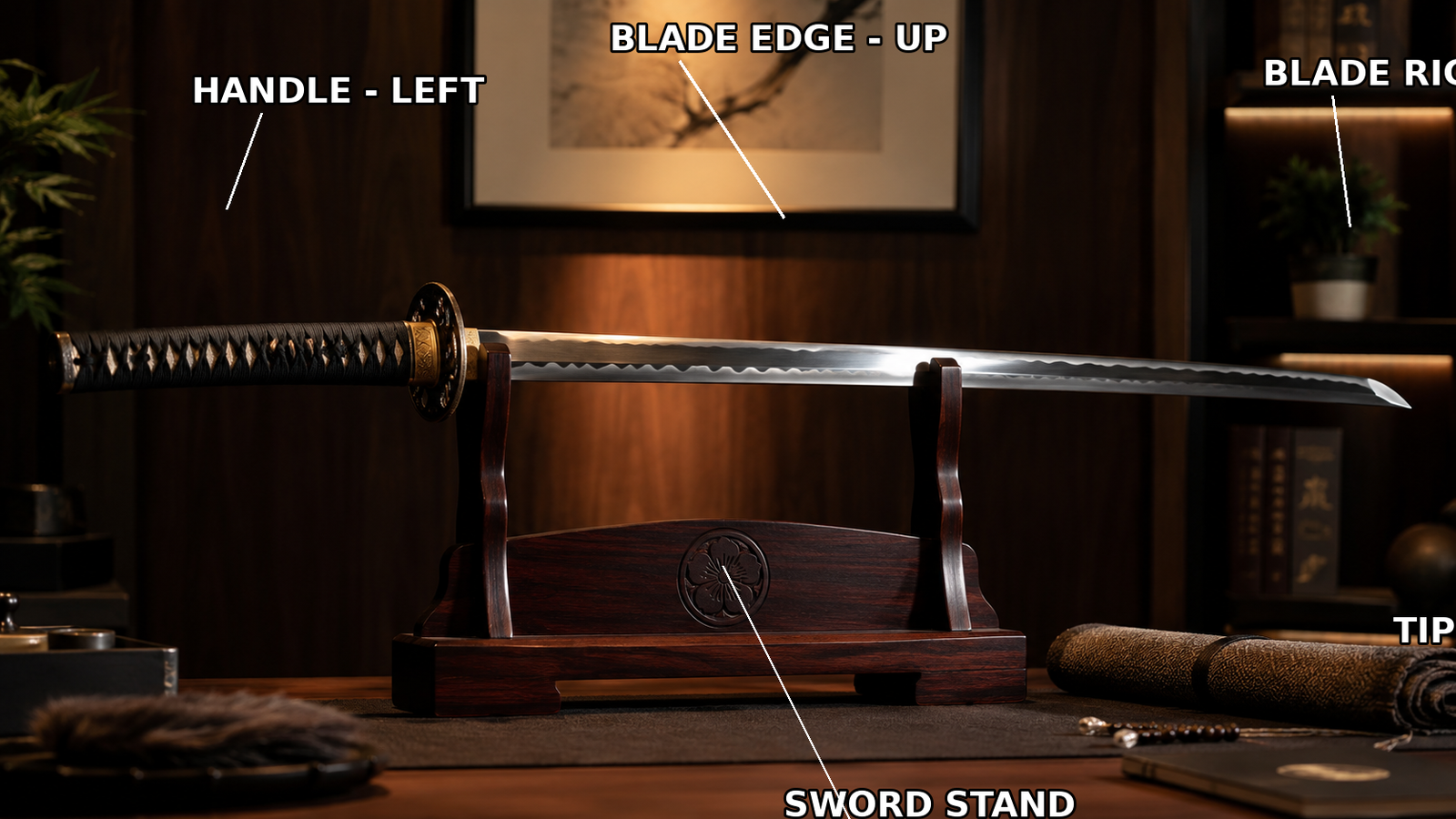
Updated for Sword Collectors, Enthusiasts & Interior Decorators | OzSwords Collection Guides
The Quick Answer: Sword Display Rules Summary
- Katana Edge Direction: Always display a katana with the cutting edge facing UP. Resting the curved blade edge-down forces the weight of the steel against the inside of the wooden scabbard (saya), dulling the edge and splitting the wood.
- Katana Handle Direction: Point the handle (tsuka) to the LEFT for standard peaceful display. Pointing the handle to the right signifies hostility, readiness for combat, or distrust.
- European & Western Swords: Mount vertically with the point facing DOWN using heavy-duty wall anchors rated for at least twice the sword’s weight.
- Display Height: Mount at eye level (1.5 to 1.7 meters off the floor) to honor the craftsmanship and protect children and pets.
Whether you have recently unboxed a high-carbon steel battle-ready katana, added an ornate European broadsword to your study, or collected official anime movie replicas, setting up your sword display is far more than an aesthetic choice. A sword is a fusion of metallurgy, historical art, and engineering. Displaying it improperly can dull its razor edge, crack expensive lacquered wooden sheaths, cause catastrophic wall collapse, or turn a prized heirloom into a rusted block of steel within a few short months.
In this comprehensive guide, we explore every facet of displaying swords correctly: from feudal Japanese martial etiquette and historical protocols to structural wall mounting physics, micro-climate environmental protection, and interior design practices for modern collectors.
1. Feudal Japanese Katana Display Etiquette: History & Rules
In feudal Japan, the orientation of a katana inside a samurai’s home was never accidental. Every position, angle, and direction communicated a precise political, social, and martial message to guests entering the residence. Understanding these rules allows modern collectors to display their Japanese swords with genuine historical authenticity.
Why the Cutting Edge Must Always Face UP
The single most universal rule of Japanese sword display is that the cutting edge (ha) must face upward toward the sky. This applies whether the sword is displayed on a horizontal desktop stand (katana-kake), wall-mounted rack, or stored inside its wooden scabbard (saya).
There are two primary reasons for this rule—one mechanical, one practical:
- Preserving the Edge Geometry: Functional high-carbon steel katanas are heavy, ranging from 1.1 kg to 1.5 kg. If the sword rests with its edge facing down, the full gravitational weight of the steel presses down against the floor of the wooden scabbard. Over time, subtle room vibrations and friction wear away the razor-sharp edge, dulling the blade without it ever cutting a single target.
- Protecting the Scabbard’s Moisture Seal: Traditional scabbards are carved from two halves of Magnolia wood (Ho-no-ki) and sealed inside with natural lacquer. When an edge rests downward, it gradually slices into this interior wooden seam. Once the lacquer seal is breached, bare wood is exposed to ambient humidity, which transfers atmospheric moisture directly to the carbon steel blade, triggering severe internal rust.
Note on Curved Blades (Tachi vs. Katana): The only historical exception to the edge-up rule is the ancient Tachi. Pre-dating the katana, the Tachi was worn suspended from a belt mount with the edge facing DOWN for horseback warfare. When mounted on a traditional vertical display stand (tachi-kake), a Tachi is displayed vertically with its tip pointing down and blade curving inward. However, for all standard Katana, Wakizashi, and Tanto, the edge must face UP.
Handle Direction: Left vs. Right (Tsuka Orientation)
The direction in which the sword handle (tsuka) points on a horizontal rack conveys the peace posture of the household. In traditional Japanese culture, right-handedness was universal among samurai due to standardized martial training.
- Handle Facing LEFT (Peaceful Display / Omotenashi): When the handle points to the left, drawing the sword quickly with the right hand is mechanically impossible. To draw a left-pointing sword, a person would have to cross their right arm over their body, invert their grasp, or reach around awkwardly—a massive tactical delay. Placing the handle to the left signals peace, hospitality, respect, and complete trust toward guests in your home.
- Handle Facing RIGHT (Combat Readiness / Hostility): When the handle points to the right, a right-handed swordsman can instantly grip the tsuka with their dominant hand and perform a fluid drawing strike (iaijutsu) in a fraction of a second. Displaying a sword handle-right in feudal Japan signaled deep suspicion, defensive hostility, military alert, or imminent conflict.
| Display Element | Standard Position | Significance & Mechanical Purpose |
|---|---|---|
| Blade Edge (Ha) | Facing UP | Prevents edge dulling and stops steel from cutting scabbard lining. |
| Handle (Tsuka) | Pointing LEFT | Denotes peace time, hospitality, trust, and non-aggression. |
| Handle (Tsuka) | Pointing RIGHT | Denotes readiness for battle, defense, suspicion, or active war. |
| Blade Tip (Kissaki) | Pointing RIGHT | Complements the handle-left peace position on horizontal racks. |
| Display Side (Omote) | Facing OUTWARD | Exposes the public side of the blade signature (Mei) carved into tang. |
Displaying a Daisho Set (Katana, Wakizashi, and Tanto)
A Daisho (literally “large and small”) refers to the paired swords worn by the samurai class—the Katana and the Wakizashi (or Tanto companion dagger). When displaying a multi-tier sword rack, hierarchy matters:
On a Two-Tier Stand:
- Top Tier: Place the Katana (long sword).
- Bottom Tier: Place the Wakizashi or Tanto (short sword).
Both blades must have their cutting edges facing UP and their handles pointing to the LEFT. Placing the shorter sword above the longer sword is traditionally reserved for specialized martial schools or unsheathed blade inspections, but for sheathed home display, the longer weapon sits prominently on top.
2. Display Rules for European & Western Swords
Western blades—such as medieval longswords, claymores, rapiers, broadswords, and arming swords—follow entirely different engineering and aesthetic rules than Japanese blades. Because European swords are predominantly double-edged and feature prominent crossguards (quillons), horizontal rack storage is less common than vertical plaque mounting.
Vertical Mounting Mechanics: Point Down vs. Point Up
The vast majority of European swords are designed to be displayed vertically on wall-mounted wooden plaques or metal heraldic brackets.
- Point Facing DOWN (Standard Display): The safest and most common orientation for Western swords is vertical with the point facing downward toward the floor. This relies on gravity to keep the blade centered between support pegs beneath the crossguard. If a mounting peg fails, a point-down sword slides harmlessly toward the floor rather than pivoting like a pendulum.
- Point Facing UP (Ceremonial Heraldry): Mounting a European sword with the point facing up is common in heraldic coat-of-arms displays (such as crossed swords behind a shield). However, point-up mounting requires specialized locking brackets that physically secure the pommel or crossguard. Never balance a heavy European sword point-up on open pegs.
The Danger of Long-Term Storage in Leather Sheaths
One of the most destructive mistakes a modern collector can make is leaving a carbon steel Western sword inside its leather sheath while on display.
Unlike Japanese scabbards constructed from dry magnolia wood, European scabbards and sheaths are made with leather. The leather tanning process relies on chemical salts, chromium, or vegetable acids. Leather is inherently hygroscopic—meaning it actively pulls moisture out of the ambient room air like a sponge. When a high-carbon steel blade (such as 1045, 1060, 1095, or 5160 spring steel) remains trapped inside leather, the trapped moisture and residual tanning acids react with the iron atoms, causing severe red rust, pitting, and permanent surface etching within weeks.
Rule of Thumb: Display European swords bare on lined wall mounts, or use custom wood-lined scabbards. If you must display a sword inside a leather sheath, ensure the blade is heavily coated with micro-crystalline wax rather than thin oil.
3. Wall Mounting Engineering: Safety, Load Calculations & Anchors
A falling sword is a serious safety hazard and can cause irreversible damage to the blade and scabbard. Standard picture hooks, adhesive strips, and thin nails are completely unsuitable for steel weapons.
Understanding Weight & Static Load Mechanics
A typical functional sword weighs between 1.0 kg and 2.5 kg (2.2 lbs to 5.5 lbs), while massive two-handed weapons like Greatswords or anime replicas (like Buster Sword variants) can exceed 5 kg to 10 kg (11 to 22 lbs). However, when mounted on wall brackets that extend outward 5 to 10 cm from the wall, the effective leverage (torque) applied to the top wall anchor increases significantly.
Step-by-Step: Securing Sword Wall Mounts Safely
Step 1: Locate Solid Wall Studs
The safest way to hang any sword weighing over 1.5 kg (3.3 lbs) is directly into a timber wall stud behind the drywall. Use an electronic stud finder to locate the stud’s left, right, and center edges. Mark the exact center line with a pencil. Drill pilot holes directly into the wooden stud and fasten the mounting plaque with 50 mm (2-inch) heavy-duty wood screws.
Step 2: Choose the Correct Drywall Anchors (If No Stud Is Present)
If you must mount a sword on hollow drywall between studs, standard plastic expansion plugs WILL pull out over time due to static pull and vibration. Instead, choose one of these specialized hollow-wall anchors:
- Heavy-Duty Metal Toggle Bolts: Rated for 40 kg+ (90 lbs+). A spring-loaded metal wing opens behind the sheetrock, providing massive rear load distribution. This is the ultimate choice for heavy display plaques.
- Threaded Zinc Drywall Anchors: Rated for 15 to 20 kg (33 to 44 lbs). These screw deeply into sheetrock and provide superior hold compared to smooth plastic plugs.
Step 3: Protect Contact Points
Bare metal brackets or hard unpadded wood pegs will scratch lacquer on scabbards and rub off blade polishes over time. Always select wall hangers lined with soft felt, high-density velvet, or smooth rubber sleeves. If your mount lacks padding, wrap soft felt tape around the contact hooks before resting the blade.
Step 4: Perform a Weight Stress Test
Before placing an authentic or expensive functional blade onto the newly installed mount, test the wall brackets by applying firm downward force with your hands—simulating double the sword’s total weight. Ensure there is zero flex, creaking, or movement in the drywall before mounting steel.
4. Environmental Conservation: Preventing Rust, UV Damage & Decay
Steel is an unstable alloy that constantly seeks to revert to its natural state: iron oxide (rust). When you place a sword on open display, it is exposed to ambient atmospheric moisture, temperature swings, atmospheric pollutants, and light radiation. Implementing environmental controls will keep your collection pristine for decades.
Managing Relative Humidity (RH)
The ideal relative humidity for displaying high-carbon steel blades is between 40% and 50% RH.
- High Humidity (>60% RH): Airborne water vapor condenses on cool steel surfaces, initiating flash rusting within hours. If you live in humid coastal regions (such as Queensland or coastal Australia), display swords in an air-conditioned room or place a dedicated dehumidifier near your display wall.
- Low Humidity (<35% RH): While low humidity prevents steel oxidation, excessively dry air causes wooden scabbards (saya), natural horn accents, and genuine rayskin (samegawa) handle wraps to shrink, warp, or crack. Maintain a stable mid-range climate.
Sunlight & Lighting Mechanics
Never mount swords in direct sunlight or across from unshaded windows. Direct sunlight emits ultraviolet (UV) radiation that causes severe degradation:
- Fades dyed cotton, silk, and synthetic handle wrapping cords (ito).
- Breaks down the clear protective lacquer on wooden scabbards, leaving them cloudy and brittle.
- Creates localized thermal spikes on dark steel, causing thermal expansion that can loosen fitted brass components (habaki, tsuba, and fuchi-kashira).
Lighting Recommendation: Illuminate your display using cool LED strip lighting or spotlights with a warm to neutral color temperature (2700K to 3500K). LEDs emit virtually zero heat and no damaging UV radiation, making them 100% safe for long-term display.
Blade Maintenance & Oiling Schedule
Swords displayed outside scabbards on open display stands require more frequent maintenance than sealed blades because open air continuously evaporates protective oil layers.
Crucial Rule: Never Touch Exposed Steel with Bare Hands!
Human skin naturally secretes invisible oils containing salts and fatty acids. When a bare finger touches carbon steel, these organic acids etch into the surface within hours, creating permanent fingerprint-shaped rust patterns. Always handle displayed blades with clean white cotton gloves or using a clean microfiber cloth.
The Standard Maintenance Procedure:
- Cleaning: Every 4 to 6 weeks, wipe down the blade using a lint-free microfiber cloth saturated with 99% Isopropyl Alcohol to remove accumulated room dust and stale oil.
- Inspection: Examine the edge and spine under bright LED light for micro-pitting or discoloration.
- Re-oiling: Apply a small drop (pea-sized) of high-grade light mineral oil, traditional Japanese Choji oil (clove-infused mineral oil), or Renaissance Micro-Crystalline Wax to a fresh cloth. Wipe evenly down the blade length to leave a microscopic, glossy barrier film.
- Avoid WD-40: WD-40 is a solvent-based water displacer, not a long-term protective oil. It evaporates quickly, leaves a sticky yellow residue, and can dissolve organic glues inside handle assemblies over time.
5. Room Aesthetic Integration: Designing a Masterpiece Display
Integrating a sword collection into your home’s interior design requires balancing visual drama, safety, and room harmony. Here are three popular design setups for modern collectors:
The Minimalist Japanese Tokonoma Style
Emulate traditional Japanese interior architecture by dedicating a clean, clutter-free wall space for your katana display. Use a dark matte wooden stand (ebony, walnut, or charred shou-sugi-ban finish) set against a light neutral wall (warm cream, soft beige, or slate grey). Flank the display stand with a vertical calligraphy wall scroll or a bonsai plant to create balance and peaceful focal harmony.
The Armory & Library Style
For collectors featuring Western longswords, medieval broadswords, or game weapon replicas, create a rich armory aesthetic using rich natural wood tones. Mount dark mahogany or oak wall plaques on dark accent walls (navy blue, deep forest green, or charcoal gray). Complement the displays with vintage leather-bound books, framed historical maps, and warm directional LED spotlighting.
The Modern Illuminated Display Case
If you own high-value collectibles or have active pets and young children in your home, glass-fronted display cabinets (such as wall-mounted shadow boxes or tall glass trophy cases) offer maximum security. Glass cases shield blades from settling room dust, ambient humidity fluctuations, and accidental handling while allowing 360-degree viewing with integrated warm LED backlighting.
6. Frequently Asked Questions (FAQ)
Should a katana be displayed edge up or edge down?
A katana must always be displayed with the cutting edge facing UP. Resting a curved single-edged blade edge-down forces the entire weight of the heavy steel against the interior wood of the wooden scabbard (saya). Over time, this dulls the blade’s razor edge and strips away the interior wood lacquer, exposing the raw wood to humidity and causing rust.
Which side should the handle (Tsuka) point on a display stand?
For peaceful indoor display, the handle (tsuka) should always point to the LEFT. Because most people are right-handed, pointing the handle to the left makes it nearly impossible to draw the sword quickly, symbolizing peace, hospitality, and trust towards guests. Pointing the handle to the right signifies high readiness for combat, tension, or hostility.
How high off the floor should a sword be mounted?
Swords should ideally be mounted at eye level (approximately 1.5 to 1.7 meters or 5 to 5.5 feet from the floor to the center of the display stand). This positioning respects the craftsmanship, provides optimal viewing angles, and keeps the functional or heavy steel blade safely out of reach of young children and household pets.
Can I store a steel sword in a leather sheath long term?
No, storing carbon steel swords in leather sheaths long-term is a major cause of rust. Leather is tanned using chemicals and salts that naturally absorb moisture from ambient air. Leaving a high-carbon steel blade sealed in leather creates a humid microclimate that rapidly oxidizes steel, causing heavy red rust and deep pitting.
How do I hang a heavy European sword safely on drywall?
To hang a heavy sword (3 to 6 lbs or more) safely on drywall, always anchor the mounting plaque or wall hooks directly into wooden wall studs using heavy-duty wood screws. If wall studs are unavailable at your desired location, use metal toggle bolts or heavy-duty threaded zinc drywall anchors rated for at least 30 to 50 lbs. Never rely on standard plastic expansion wall plugs.
How often should I oil a sword that is on display?
A sword displayed openly on a rack or wall mount should be cleaned and freshly oiled every 3 to 6 weeks, as well as immediately after anyone touches the steel with bare skin. Use light mineral oil or traditional Choji oil. Skin oils contain acidic compounds that cause permanent fingerprint rust if left untreated.
What is the proper way to display a Daisho (Katana and Wakizashi set)?
On a traditional two-tier stand (Kake), the Katana (long sword) is placed on the top tier, and the Wakizashi (short sword) is placed on the lower tier. Both blades must have their cutting edges facing UP and their handles pointing to the LEFT. When displayed in full scabbards, this arrangement reflects feudal Japanese samurai decorum.
Does direct sunlight damage displayed swords?
Yes. Direct sunlight contains ultraviolet (UV) radiation that degrades the organic materials on a sword. UV rays fade and break down silk and cotton handle wraps (ito), dry out genuine rayskin (samegawa), crack lacquered wooden scabbards (saya), and accelerate metal oxidation by creating localized heat spikes.
